
Last week Ben and I welcomed two friends aboard Elizabeth for an afternoon sail. It was the first sail of this season, and we were excited to dust off the cobwebs. We headed out into the bay, hoisted the sails, and set a course for the opposite shore. The chilly air was reminiscent of a summer day in Newfoundland, and the sea spray that struck our faces tasted of salt and smelled of new beginnings.
We toured around the bay, tacking and gybing, sailing full and by, and then bearing away, we made a run back toward home. Upon entering the channel, Benji on the bow shouted back to our guest at the helm. “Have you ever heard the phrase Red, Right, Returning,” he asked and was met with a confused look.
“What does it mean,” she replied?
As we proceeded to explain to her about the channel markers, their colors, and shapes, and what they mean, her face went from curious to excited.
“And I thought red meant stop and green meant go!” She exclaimed with laughter.
It was just after sunset, and although the sky was still bright, boats all around began switching on their lights.
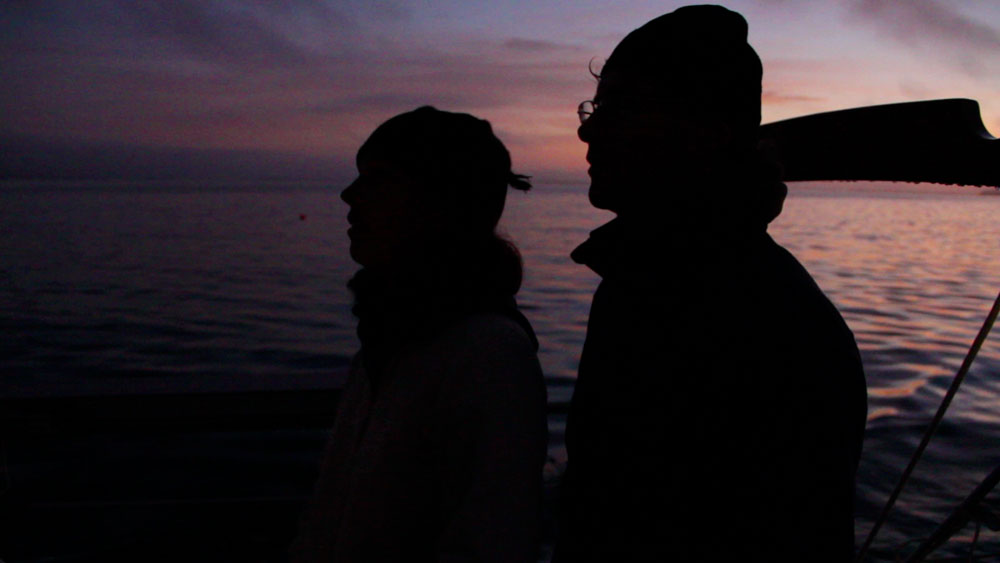
She asked more questions about the red triangles, green squares, red buoys, red, white, and green lights, and even the red and green bits of yarn that were sewed into our sail.
“But if only a few colors are used to represent so many different things, how do you possibly remember it all?
So, we recalled all the useful mnemonic devices we could think of off the top of our head. Here is our list (and their general meaning)…are we forgetting any good ones? Share your best ones in the comments below!
Red, Right, Returning
-used when navigating in a channel
Green, Right, Going
-used when navigating in a channel
Do you have any red port left?
-the port (left) side of the boat has red lights
Red over Red, Captain Is Dead
-vessel not under command
White over Red, Pilot Ahead
–pilot vessel on duty
Red over Green, Sailing Machine
-optional sailing vessel lights
Red over Red over Red = Rudder Rubbing Rocks
-vessel constrained by draft – international rules
Red over Red over Red, big F*%&#in vessel ahead
-vessel constrained by draft – international rules
Green over White, Trawling Tonight
-fishing boat towing nets
Red over White, Fishing Boat Light
-general fishing lights (not trawling)
(please note, these apply to USA except where noted, and are not comprehensive, rules vary in other countries)
Comments 25
Pingback: Red, Right, Returning – Sailing, Simplicity, and the Pursuit of … | Sailing Times
Thanks! Nice way to remember all those things.
Oh, dear. I would be worthless as a navigator. You lost me at “Righty tighty, Lefty loosey.”
Red Left Leaving. I also remember the shape of the green buoys by comparing it to a 7-up can!
Three in turn, Power astern
Slowing or stopping to avoid risk of collision
Blast quick five To stay alive
Imminent danger of a collision
“Blast quick five to stay alive.” Fantastic. If only my air horn was someplace handy…
Nature sends us color signals as well 🙂
Red sky at night, sailor’s delight;
Red sky at morning, sailors take warning.
My son gave me a pocket watch with that engraved on it
Works well! It is not obvious, tugohh. Will new users know to click on the yellow bubble or time stamp?Within the thread itself, perhaps you can put the same yellow bubble next to the title of the thread to keep things consistent? Maybe a yellow bubble with a down arrow?
Our New Reels Catch Fish, So Purchase Some
Overtaken
Not Under Command
Restricted in Maneuverability
Constrained by Draft
Fishing
Sailing
Power Driven
Seaplane
Used to remember the “pecking order – or Who has the right of way over whom.
True Virgins Make Dull Company At Weddings
to convert true degrees to compass course
True
Variation
Magnetic
Deviation
Compass
(add west)
You guys are awesome! Keep up the good work ~ Al
Another good set. Thanks, Al!
The true (blush) way I learned port from starboard:
My favorite comfy spot to sit and drink a glass of port after dinner happened to be on the port-side of the old boat.
Now I’m wondering, how did these things get their names originally anyway?
the other 3 r’s:
RED REFT REAVING!
I made this up for my sailing friends:
red, left, port: the short words go together
green, right, starboard: the long words go together
A simple but great one!!
How would this work for people who are colorblind? It’s relatively easy while driving, since I can just remember the top/bottom positioning of lights, but it doesn’t sound like that would work in this situation.
Author
Jesse,
Thats a great question. Actually, if the sun is behind the buoy or day mark, even people with color vision can’t make out what the color is. That is why they made the shape of the buoy also important. All green buoys have a flat top. They are often called “green cans.” Red buoys have a pointed top. They are called “red nuns.” Day marks are flat pieces on a post. Often they are metal or painted wood. The red ones are shaped like triangles and the green ones are squares to match the pointed and flat tops of the buoys. I don’t know a solution for you for viewing the lights at night. I wonder if captains of big ships have to have their eyes tested and if restrictions are imposed on people because of their vision, similar to pilots and drivers . Actually, come to think of it, I had to have a physical exam to get my USCG Captain’s license. But my vision is fine so I have never encountered this problem. Maybe some others know the answer. Its a great question so I think I will present it on Facebook and see what responses come. The conversation on FB is usually very good and I learn a lot from that community.
Sincerely,
Teresa
That’s why green is square and red is a triangle.
An instructor of a piloting class had a good teaching aid to remember bouys, a can of Seven-Up. It’s green, can shaped, and has a “7” on it, an odd number.
First, I’d like to say thank you for the blog and wonderful videos. I recently discovered them and have been thoroughly enjoying them. Now, to point at hand, back in the day I had learned the phrase for shapes and colors as “Even red nuns have odd green cans.” Also, the reverse of computing from True to Compass – “Can Dead Men Vote Twice At Elections”.
My Dad was a sailor, on freighters going to the Far East back in the 1920’s. He used to recite a poem about buoys and sea
rules, written to help new sailors remember the buoys and what they meant, that I’d like to find, because no one wrote it down.
Where would I look for such a thing?
On applying variation and deviation:
“Compass to true: the signs will do.
True to worse; the signs reverse.”
Questionable old fashioned weather advice:
“When the sea-hog jumps
Look out for your pumps.”
More reliable weather tips:
“When the wind shifts against the sun
Trust it not, for back it will run.”
“At sea with low and falling glass
The greenhorn sleeps like a careless ass
But when the glass is high and rising
May soundly sleep the careful wise one.”
“If the rain before the wind, tops’l sheets and halyards mind.
If the wind before the rain, soon you shall make sail again.
Mackerel sky and mares’ tails
Make lofty ships carry low sails”
These and some other found and explained in Cruising Under Sail by Eric Hiscock, though obviously not their original source.
Here’s one they teach here in Australia: ‘Green to green when going upstream”